
 What actually happens is not always in the history books.
I grew up in California in the 50’s, graduating from high school in 1961, only 16 years after World War II ended. So how was it possible that in all my classes there was not one mention of the internment of Americans of Japanese descent?
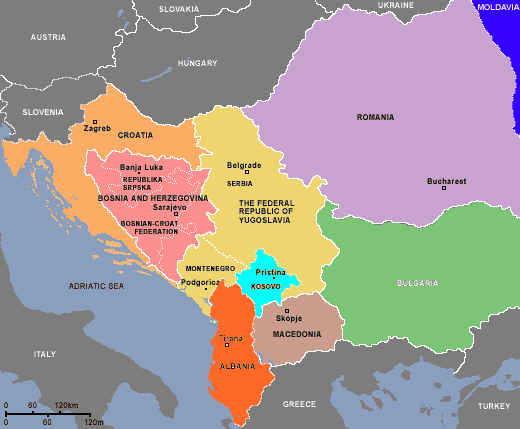
Some of these forgotten or overlooked episodes eventually do get remembered. Some never do because of politics, prejudice, embarrassment, and in the case of Bulgarian independence, lack of interest. Americans, provincials we are in the main, simply do not care much about Bulgaria…or even know where it is (see above, Bulgaria in green).
The recent declaration of independence by Kosovo got me thinking about the Balkans and how the roads of conquest and domination have passed through southeastern Europe for centuries.
And then I discovered Januarius Aloysius MacGahan, a farm boy born in Pigeon Roost Ridge, Ohio, in 1844, who became the one of the most famous reporters of the 19th Century. His exploits are charted in Famous War Correspondents By Frederic Lauriston Bullard, published in 1914 by Little, Brown and Company, a scan of which I read online.
 Starting first as a Civil War reporter for the St. Louis Democrat, MacGahan, at the suggestion of Gen. Philip Sheridan, journeyed to Europe in 1868, planning to learn Latin, French, and German, and eventually return home to study law. He arrived just before the Franco-Prussian War, interestingly referred to by Bullard as the “great war” (his book was written just before The Great War, the War to End All Wars, began…not surprisingly in the Balkans).
In Brussels, MacGahan met a representative of The New York Herald and talked his way into a job as a special correspondent. His subsequent descriptions of France’s disastrous defeat in Switzerland in 1870 and interviews with leading statesmen of France (Léon Gambetta, Louis Blanc, and Victor Hugo) attracted wide attention in America and Europe. Bullard writes: “The behavior of the young American throughout those days of peril, his courage, tact and industry, made him famous…. He sent out graphic and accurate letters which were copied by the papers of many countries.”
The most famous “embedded” British reporter of the time, Archibald Forbes, said of MacGahan, “Of all the men who have gained reputation as war correspondents, I regard MacGahan as the most brilliant.”
When France surrendered in 1871, MacGahan reported on the resulting anarchic chaos in Paris, narrowly escaping death, and was arrested as a Communist. With France executing scores of Communists, only U.S. diplomatic intervention got MacGahan released. Then, after reporting throughout Europe, in 1873 MacGahan gained international notoriety by dogging and reporting on the Russian army, without Russian permission, for hundreds of miles across the Kizil Kum desert as it attacked Muslim forces in what is now Kazakhstan and Uzbekistan.
(Isn’t this sounding more and more like a Hollywood movie script?)
“Then, in 1876, writing now for the Daily News of London, MacGahan received a fateful assignment to cover the Turks’ pacification of Bulgarian rebels. What MacGahan found in Bulgaria, and his skill in reporting it, would do more than merely inform a curious public. It would change the course of Eastern European history.” (from Januarius A. MacGahan: Daring to Tell the Truth by Joseph E. Gannon, a short, but very well-written account on MacGahan’s life)
 MacGahan’s reporting of the Turkish massacre of Bulgarian civilians in Batak (“Between the church and school there were heaps [of bodies]. The stench was fearful. … There were 3,000 bodies in the church yard and church.”) caused Britain, which had been supporting Turkey in order to balance Russian advances in the region, to abandon the Ottoman Empire, leading to the Russo-Turkish War (1877-78) and eventually to the establishment of Bulgaria as an independent country. A reporter now on a mission larger than mere reportage, MacGahan died of typhus in Constantinople in 1877. He is buried in New Lexington, Ohio,
  under a tombstone that reads: Liberator of Bulgaria.
To this day, MacGahan is remembered in Bulgaria; there is a street named after him in Sofia, the capital. But even though his exploits were well known during his life and for many years afterwards (Theodore Roosevelt wrote of him in Through the Brazilian Wilderness, Charles Scribner’s Sons, 1914), he is now almost entirely forgotten except in Perry County, Ohio.
The Perry County Historical Society has a readable account of his life, as does Wikipedia. There is one biography, first published in 1988 and recently reissued, by Dale Walker: Januarius MacGahan: The Life and Campaigns of an American War Correspondent.
These days, we get Wolf Blitzer.
22 Comments on “Liberator of Bulgaria”
Isn’t that the way most important people are forgotten about when they done a lot for our history. I know I have a relative that way that marched with George Washington at the Delaware.
Carolyn:
Actually, most *important* people are remembered by historians. But…who defines important? In McGahan’s case, his signal achievement was in a faraway land largely unknown (and economically unimportant) to Americans. America has had little to do with Bulgaria since its independence late in the 19th century. On the other hand, if McGahan had been the father of Irish independence, he’d probably be featured in every St. Patrick’s Day parade!
Also note that that number of Bulgarian-Americans is small (the United States Census of 2000 shows only 63,000 people of Bulgarian descent in the US). Not surprisingly, there has been little internal push to remember his contribution. Since the fall of the USSR, however, the number of immigrants from Bulgaria and the number of Bulgarian students studying in the U.S. has risen dramatically. But my unscientific survey (I asked three Bulgarian students and none had heard of McGahan) underscores the USSR’s self-serving presentation of history. Since Bulgaria had been dominated by the USSR since 1945, I suspect Bulgarian independence (and therefore, McGahan) was downplayed or excised from history textbooks.
God Bless His soul!
The thankful Bulgarians!
We, the American Bulgarians from Florida (Tampa Bay – St. Petersburg), are planning to visit the grave of this Great Man, in fall and leave flowers as a sign of our love and respect that will never die in the Bulgarian hearts.
Konstantin Ivanov
(Bulgarian Historical Committee
St. Petersburg – FL)
I seek Bulgarians in the Tampa Bay area to invite to a cultural event featuring the music of Bulgarian composer Todor Popov. This even will take place 5/15/2010. It is a lecture recital with a small choir to sing the music. I want to make an email list and US mail list of Bulgarians and their friends to invite.
I have discovered this site too late, sorry!
It’s never too late to recognize a hero.
Konstantin–
In your opinion, do people in Bulgaria know who MacGahan is?
The answer is “Yes.” In the capital of Bulgaria there is a street named MacGahan. In the school books in History (mandatory for middle school), it is mentioned the merit of Mr. MacGahan for visiting himself the most damaged (by the Turks) villages and small towns, and informing the World about the bloodshed caused by the Turks. Unfortunately, Bulgaria was 50 years under Soviet slavery and everything American was discriminated against, starting with blue jeans and coke and finishing with History. I am not telling that the name of MacGahan was completely shadowed, but still we don’t have a monument to this bright fellow. That is a shame on us, but the people are still busy with their struggle to establish a democracy. Nevertheless there is another American connection to the Bulgarian liberation: the Russian king Alexander II (king Liberator) sold Alaska to the USA for 7mil golden USD, and with that money financed the Russian-Turkish war in 1877-1878 for liberating Bulgaria.
Too brief mention is made of the role of “communism” in France around 1871 in this blog.
Take another look: http://amadlandawonye.wikispaces.com/1871,+The+Civil+War+in+France
Much more interesting than Bulgaria at that time is France, esp. Paris, double-esp. the Paris Commune.
When will we learn?
When will we remember?
Every true Bulgarian knows his name and what has he done. We have many memorials of him (I know at least two), many books and movies about him… And I am sorry, but all my books about MacGahan are from the years of the “Soviet slavery”. Today is not politically correctly to speak about him as a hero. Why? Because we will insult our allies from Turkey. I don’t care about that and now I am searching, is there any memorial of this great man in US…
Bulgarian:
For information about a memorial to MacGahan, you can try:
http://themacgahanfoundation.netfirms.com/
This website states that there has been a festival every year in early June in New Lexington, Ohio, (Perry County is where MacGahan was born) but because the website appears last updated in 2005, the last festival may have been four years ago. There are some names there to contact for further info.
Yes, the people who need info about the MacGahan festival can contact me: [email protected]… I go there every year since I found out in 2003 from a local man in Ohio …I can give you all the detail and how to get there…Carma Jean Rosh is in charge of the organization and I can you put you in touch with her as well so that you can get the yearly updates on the meetings.
Hi, on the map, skopje’s true name is F.Y.R.O.M.
I vividly remember seeing the street named after Mac Gahan (spelled MAKGAHAN) after this glorious person who actually recorded his observations in Bulgaria at the time he was there. I have wondered what kind of a name that was considering the difference between this name and the other street names in Bulgaria. Now, several years later I found out why the street was named that way and who Mac Gahan is!!!! All I can say is: Thanks to this brave hero we have some valuable history lessons to learn!!!!
Hi Steve, just found this blog post and I wanted to compliment you on it. So many wonderful and influential characters in history like MacGahan are lost to history. I also want to thank you for giving clear credit and a link back to our website within your post. So many bloggers grab our stuff and post it without doing that, it’s refreshing to see someone doing the right thing.
Mr Cotler,
Thank you for pointing this out! Did you also know that Bulgaria saved all the Jews from the Holocaust, except the annexed lands of Greece and Macedonia, but no one talks about it either incuding at the University level. I live in Ohio and I found out about McGahan in 2003 from a local man… if anyone is ineterested each year in June around the 11 or the 12th we celebrate in New Lexington Ohio, where he was born, near by. Bulgarians from all over come and the VP of BG was there in 2009…. If anyone is interested you can e-mail me at [email protected]. I think Ms. Clinton just visited BG for 5 hours…but there was a deal she needed cut for some kind of a Gas contracted… which was in the millions…I have stoped getting upset about who cares and does not about Bulgaria…the fact that there are small countries that still exist and have not been completely submurged is a miricle to me…it is another question of how economics favor the population based on the deals that are cut amongst the politicians – Great or Small Powers… Africa is very unstable… does anyone ever wonder why??? Not much different with smaller countries… but you are right ..it is good for one to know history… even if that country is no longer big and mighty…
A nice read. Speaking as a graduate of New Lexington High School its kinda nice to find out that he is known outside of New Lexington. There used to be a man that would tell MacGahans story not sure if he is still active but that was one of the more interesting assemblies I went to.
Oh, how very cool to stumble across this!
The Januarius MacGahan American-Bulgarian Festival will be held in New Lexington, Ohio on Friday and Saturday, June 13 and 14, 2014.
Those attending are welcome to join the group Friday evening at the Januarius MacGahan Council #1065 Knights of Columbus Hall on Jefferson Street, near Monument Square park at 7:30 p.m.
On Saturday morning the group will hold a Memorial service at 10:30 a.m. at Maplewood Cemetery, New Lexington, Ohio.
A luncheon and program will follow at the Perry County District Library, New Lexington, Ohio.
A video of the Rick Sowash performance of “The Life and Times of Januarius MacGahan” will be featured.
Julia Paxton will be speaking about attending the Dearflympics in Sofia Bulgaria last summer.
The festival is open to the public at no charge for the luncheon
For further info contact Barbara Mooney at 342-1088 or Carma Jean Rausch at [email protected]
The monument of MacGahan is created by the Bulgarian sculptor prof. Lubomir Daltchev. He is a Bulgarian dissident and contrary to the usual monuments that are trying to create very important images, his monument shows MacGahan in movement close among the people. Initially the monument was put on the main street, where the people were capable to move around it and and to feel that MacGahan is one to them. Daltchev is among very few sculptors capable to create the illusion for movement with the static forms of the metal. Daltchev has many monuments in several countries. One of them is about the victims of the Nazi camp in Mauthausen in Austria. The former Bulgarian State Security made several attempts on his life, two of them performed by masked orthodox priests, but he survived. In Bulgaria his large studio was totally destroyed and books about his art forbidden. Still the State Security documents about him are not released. His grave is in the famous Crystal Cathedral near Disney Land in California.
More about Bulgarian -American community here http://dirbg.us
Comments are closed.